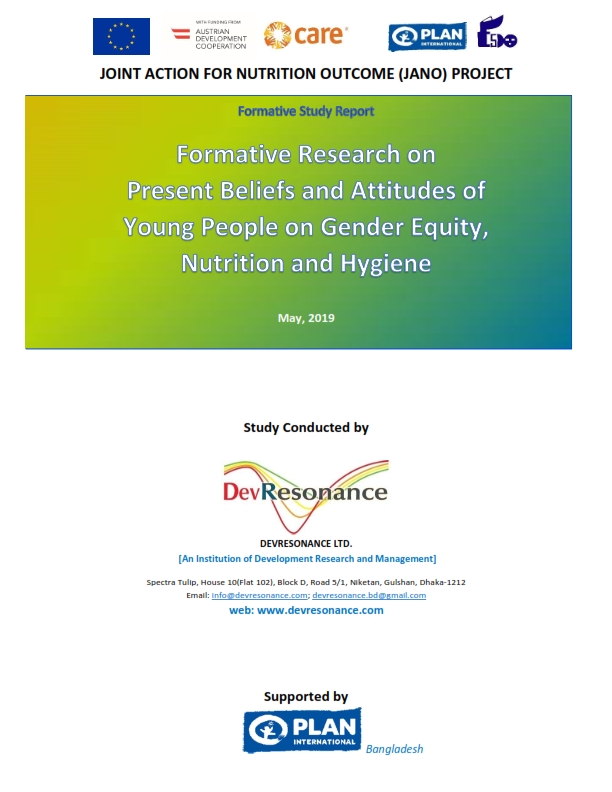
Formative research to understand present beliefs and attitudes of young people in Northern Bangladesh area about provision of gender equity, nutrition and hygiene.
Plan International Bangladesh, in collaboration with JOINT ACTION FOR NUTRITION OUTCOME (JANO) PROJECT, implemented by Care and Plan International, and supported by EU and Australian Development Cooperation, carried out a formative research to understand present perceptions and attitudes of young people on gender equity, nutrition and hygiene. The coverage of the study was spread out across 3 upazilas of Rangpur district (Gangachara, Kaunia and Taragonj) and 4 upazilas in Nilphamari district (Domar, Jaldhaka, Kishorgonj and Nilphamari Sadar). Both quantitative and qualitative methods were used to collect information from young people at intervention schools and Madrassas regarding the primary research issues which were gender equity, nutrition and WASH. The sample pool of interviewee accounted for 576 students from primary, junior secondary and secondary school. It was taken into consideration that there were equal representation of adolescent girls and boys to be surveyed. Additionally, health service providers, agriculture, livestock, education and women affairs department at upazila and district level were also interviewed. Some of the specific objectives of the study was to reveal beliefs and attitudes of youth aged between 10 to 19 years on key gender equity and nutrition issues, to understand the attitudes of the parents, teachers and School Management Committee (SMC) members in primary and secondary schools and Madrassas, health service providers in Community Clinics and Union Health and Family Welfare Centre (UH&FWC) towards provision of Gender Equality Monitoring in School (GEMS), hygiene (Menstrual Hygiene Management), hand washing practice and nutrition for young people. The study went on for a course of four months from February to May of 2019.
Reviews
There are no reviews yet.